Drone regulations in Thailand (2026)
Verfasst von Francis Markert | Last update on 06.05.2026 | 519 Kommentare
If you want to fly your drone in Thailand, there are several hurdles to overcome. Here I explain the requirements you need to fulfill.
In recent years, the rules for drone pilots in Thailand have changed very frequently. As a result, there is a lot of confusion and not all information you find online is up to date. I will try to give you the most current and comprehensive overview possible of the legal situation in the Kingdom of Thailand.
First of all: if you are caught flying a drone without the necessary permits, you could face heavy fines and even prison sentences. Thai prisons are no joke!
The drone flight bans on the islands of Koh Chang and Koh Mak in Trat Province have been lifted.
However, private drone flights remain prohibited in the Pattaya district and in provinces bordering Cambodia (e.g. Koh Kood). Please do not fly your drone in these restricted areas – otherwise you may face imprisonment and/or fines.
Regardless of this, all flights must still be registered via the official CAAT app. The app also displays the currently active no-fly zones.
Background:
Due to military tensions with Cambodia, the regulations for drone flights have been adjusted. As the situation may change at short notice, you should regularly stay informed about the latest developments. You can also receive all current information from our partners when using the service below.
The CAAT has significantly simplified the approval process for drone flights:
- Restricted Zones (blue areas in the app): Permits can now be requested directly in the official CAAT app and flights can also be registered there. Processing usually takes about 3 days.
- Open Zones: No prior approval is required anymore. Simply register your flight in the app – and you can take off just a few minutes later.
Important note: Another rule change has already been announced – and it is expected to be more restrictive. However, it will not come into force for another two years. Until then, the simplifications mentioned above remain valid. Since regulations may change at short notice, we recommend checking the latest requirements before traveling.
For most camera drones, you need two registrations: first with the National Broadcasting and Telecommunications Commission (NBTC), which handles the frequencies used by the drone, and second with the Civil Aviation Authority of Thailand (CAAT), which registers both drone pilots (after an online test) and aircraft.
Practical Permit Service
Obtaining both registrations can take a lot of time and nerves. If you would like to try it yourself, you will find a detailed guide further below. However, you can also hand over the entire process to two experts in Thailand who will handle everything for you for a small fee. If you would like to use this convenient service, simply fill out the form below. We receive many inquiries about difficulties during the application process, which is why we can highly recommend the permit service of Stefan and Walee, both of whom live in Thailand.
How quickly you can get the permits
If you use the service, you can expect the following processing times:
- CAAT: 1–3 business days after the entry stamp has been submitted and the account has been confirmed with a Thai phone number.
- NBTC: 1–3 business days (depending on the responsible office)
Processing times may be longer during Thai holidays such as Songkran, Loy Krathong, and Chinese New Year. Ideally, however, it is possible to receive all permits the day after arrival.
What is required from you
In addition to your details about your drone and your stay in Thailand, Walee and Stefan will need photos of your drone and passport as well as your signature on several documents. You will also need a Thai phone number, which is easy to arrange. They will take care of the rest for you.
Overview: Drone rules in Thailand
Drone labels can be ordered here
CAAT: 0066 (0) 2568 8815
Below I explain how the procedures with the NBTC and CAAT work.
Drone Registration in Thailand
Overall, you need three documents to fly legally in Thailand: an English-language confirmation of your drone insurance, the NBTC registration, and the CAAT registration. To avoid any issues, you should carry these documents with you during all drone flights.
Get Drone Insurance
The insurance confirmation should be issued in English and include the following details:
- Full name of the policyholder
- Brand, model, serial number, and weight of the insured drone(s)
- Coverage in Thailand must be clearly stated
- The insurance period must include the duration of your trip to Thailand
- Insurance coverage of at least 1 million THB (approx. 30,000 EUR)
Registration with the NBTC
Before the COVID pandemic, you had to visit one of the NBTC offices in person for registration. Fortunately, this process has now finally been digitized, allowing you to prepare this step before your trip to Thailand. First, create an account here. Once your email address has been confirmed, you can already enter your contact details and your address in Thailand. However, for the actual registration of your drone, a photo of your entry stamp is required, which you receive in your passport upon arrival. Therefore, you can only complete the NBTC registration once you are in the country.
The fee for drone registration with the NBTC is 214 Baht and must be paid at a Thai bank. A good option is Krung Thai Bank. Not all Thai banks are able to process the NBTC payment.
If you fail to register with the NBTC and are caught by the police, you could face up to five years in prison or a fine of 100,000 THB (approx. 3,000 EUR).
Registration with the CAAT
Since 2025, you need two confirmations from the CAAT. The first is a pilot license for yourself. To obtain it, you must complete a test with 40 (sometimes bizarre) questions. The drone pilot license is valid for two years after issuance.
Secondly, your drone itself must be registered. After registration, the aircraft receives a unique ID that must be attached to the drone. This ID is valid indefinitely and can also be used for future trips to Thailand.
Since 2025, registrations can be completed via the online platform uasportal.caat.or.th. A Thai phone number is required for registration. You can purchase a SIM card directly at the airport or in many supermarkets (e.g. 7-Eleven).
Large parts of the user interface are in Thai. However, the relevant fields have been translated into English. During the process, you will need to provide a lot of personal information. You must also upload a photo of the drone showing the serial number and proof of your drone insurance. In addition, the CAAT requires a copy of your passport including the entry stamp.
If you are caught flying without CAAT registration, you could face up to 1 year in prison and/or a fine of 40,000 THB (approx. 1,200 EUR).
If you want to fly homemade drones in Thailand, we unfortunately have to disappoint you. If your drone does not have a serial number, it is almost impossible to obtain registration from the aviation authority.
Frequently Asked Questions About Drone Rules in Thailand
Here are answers to the questions most frequently asked in the comments:
Additional Regulations for Flying Drones in Thailand
After successfully registering your drone, additional rules naturally apply.
If you are flying privately and your drone does not have a camera installed, the maximum take-off weight is 2 kilograms. Above this weight, you need approval from the CAAT. From a take-off weight of 25 kilograms, you additionally require special permission from the Ministry of Transport.
Commercial pilots require permission for their flight operations.
Safety Distances and No-Fly Zones
You must keep a distance of 9 kilometers (= 5 nautical miles) from airports.
You may approach people, vehicles, and buildings only up to a minimum distance of 50 meters.
You are not allowed to fly near crowds of people. Flying over cities and villages is prohibited. You should also avoid government buildings, military facilities, and hospitals.
Flying drones in national parks requires permission from the park authorities. Rangers are increasingly checking whether these permits are available.
For take-off and landing, you must always obtain the permission of the property owner. In practice, we usually solve this by asking security guards for permission or checking at information desks.
Your drone must always remain within visual line of sight.
Drone flights in Thailand are only permitted during daylight hours, i.e. between sunrise and sunset.
Thai regulations also require you to have an emergency plan. This includes carrying a fire extinguisher with you. We have not yet found out whether this is actually checked.
Flight Zones and App-Based Permissions
In its official app, the CAAT distinguishes between different flight zones marked in various colors. Different rules apply depending on the zone:
- Open Zones: No prior approval is required. Simply register your flight in the app and you can take off a few minutes later.
- Restricted Zones (blue areas): Approval is required, but can be requested directly in the app. Processing usually takes around 3 days – plan this accordingly during your trip.
You can see which zone applies to your planned flight location directly in the CAAT app. It is worth checking the app before every flight.
Good to Know: Additional Special Features in Thailand
In Thailand, the minimum age to operate a drone is 20 years.
Flights within the city area of Chiang Mai generally require approval from air traffic control because the airport is located so close to the city. We were able to obtain the corresponding permission ourselves. However, you should call several days in advance so the tower staff can coordinate with their supervisors. In addition, approval is required for flights over the historical park of Ayutthaya. Permission is issued by the Historical Park Office, which is open daily from 8:30 a.m. to 4:30 p.m. According to the tourist information office, the permit costs either 3,000 or 5,000 Baht – the staff were not entirely sure anymore.
So that you always have the most important rules at hand, we have additionally summarized the key points in a document exclusively for Plus members. Download it now and take it with you on your next trip to Thailand.
[wpdm_package id=’28894′]
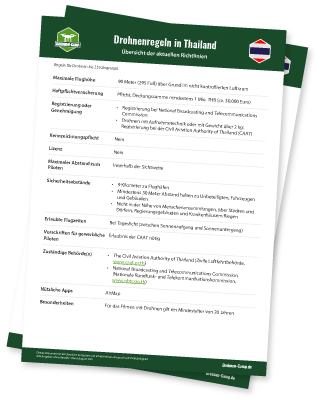
So that you always have the rules at hand, we have additionally summarized the most important points in a document exclusively for Plus members. Download it now and take it with you on your next trip to Thailand.
Jetzt Plus-Mitglied werdenSchon Mitglied? Jetzt einloggen
We have researched the drone regulations for Thailand listed here to the best of our knowledge. However, we cannot guarantee the accuracy of the information. If you want to be absolutely certain, contact the Thai aviation authority. Alternatively, you can also contact the Thai embassy in your home country for more information about the regulations. Please leave us a comment if you learn any news and/or have your own experiences flying a drone in Thailand!

I’ve just received my CAAT certificate in advance before travelling to Thailand and with a very cheap 1 month only insurance !
I will apply for the NBTC one I’m in Thailand as I will need the entry stamp 👍
Where did you buy the drone insurance and how much did you pay???
I wanted to point out that I also received CAAT registration prior to arriving in Thailand. It is the NBTC that causes a challenge because it does actually require the passport stamp and to be in the country. My suggestion is have all your images, documents and everything lined up prior to arriving in Thailand and then as soon as you arrive in Thailand, submit the application for NTBC. The CAAT is good for 2 years, NBTC is based upon your visa or time in Thailand. For example Visa on arrival from USA will be 30 days of NBTC registration. You can renew (extend) it in the case you get a visa extension.
Opensky app is very helpful as you can submit a request to fly directly to the authorities and receive permission within a day or two but initial registration for OpenSky app takes a few days. The challenge with opensky app is, let’s say for example you want to fly along the river near icon Siam or in the middle of Sukhumvit – ok cool no problem. However, you must get written permission from property to be able to submit request on opensky app. So it’s like this – get written permission from property, take picture of the permission document, include that image of document along with outline of flight path, flight ceiling, time of day, duration of flight, etc., you will see the app has boxes for information it requests from you. Then you upload all that, wait a day or two and receive approval to fly. Then you are good. I have done this directly over Sukhumvit and I launch from my condo roof. My landlord gave me permission in writing, I submit and no problem. The challenge lies in that many Thais are unaware of drone laws and instead of saying I don’t know they try to tell you to call the police or they give excuses such as “the embassy is nearby” or something. There needs to be education on this matter because so much more awesome YouTube content and great videos could be in existence if people who are like myself, who don’t want trouble and to just be able to fly legally, could get easier approvals to fly because people are aware of the process of drone operations. But they are not.
Anyway, I would like to point out that currently opensky app is only really available in and around bangkok. Phuket and Krabi, up north and Issan regions are totally different. No opensky app. Still need NBTC, still need CAAT, insurance, fire extinguisher etc. but mostly just ask front desk/security guard permission, you’re good to go.
I have a Dji Mavic Air and friends in Thailand tell me it is to old to register so cannot be flown there. Can anyone advise if this is correct please.
Thanks in advance.
Adrian
Ok I am confused a bit. I have a couple of small drones with NO CAMERA and less than 2kg.
What is the process for these. Do I still have to register with NBTC, but not CAAT?
What about RC planes and helicopters
Without a camera and with a camera?///
When registering with CAAT, on the 2nd screen I’m unable to upload more than 1 photo because the upload screen only allows 1 upload file(can only select 1 file) and thus my registration gets rejected. After hitting “Submit”, I see new registration request in the History but there’s no link to upload more files. Anybody else run into this issue?
I recommend to combine all documents in one file
what about in national parks?
Hi Jea,
as far as we know, it is not forbidden to fly drones in national parks. But we can’t guarantee that.
Stay safe, Francis
feb 2024
unfortunately my request was not approved because of the lack of the immigration arrival stamp. Normally, i always apply after arriving in Thailand including the stamp ,and it was always approved. After reading about people uploading copy passport twice, instead of the arrival stamp, i thought to give it a go and try it out)
But for me it was not approved. So i will finish it after arrival in the country
I was looking at the list of where you can’t fly and it appears that there are not too many places where you can in most of the islands. Is it worth all the hassle? There seems to be a lot of drone flying in those areas all over YouTube. It seems a minefield for those who do not want to get on the wrong side of the law.
I would like to know the maximum weight limit is please.
Also to fly national parks you are going to have to apply for your flights, apply to the park office. e.g i was refused flight on koh chang due to no national park licence 6/4/2024
Hi, where do you have to apply in koh chang ? is thé licence free ? do they always accept applications ?
thanks
Does one need to pass an online test like watching a video or similar, during the registration process ? Thanks
No, that is not necessary!
Hello good day, were planning to travel to Thailand this dec but less than 30 days, do we still need to register our drone?
Yes, registration is necessary.
Hi. Please, we are flying to Thailand in February for two weeks and I want to take my DJI Mini 3 Pro. I would like to take the opportunity to get all the paperwork (CAAT , NBTC) from Stefan and Walee, living locally. However, I would like to ask if anyone has experience flying around Railay + surrounding islands (Koh Poda, Koh Hong, Koh Yao Yai/Noi…) as well as Khao Sok NP and Khao Lak. I assume that specifically in Khao Sok NP I will need to get permission from the national park authority.
Thanks.
Hi David,
for national parks, you need permission from the local National Park Authority. Walee and Stefan can support you with some guidance.
Kind regards,
Francis
Hi there
I bought a drone from USA.
Is it’s ok I can bring to Thailand?
Or I better register first? Before I go to Thailand?
Hi Chotika,
It is important to complete the registration process before your first flight in Thailand. The sooner you start, the sooner you can fly your drone. However, you can also start taking care of the permits in Thailand.
Best regards,
Francis
Hi All,
I’ve come across information stating that drones must be registered within 30 days of entering Thailand. I also understand that drones can be flown during this 30-day period, provided you have valid insurance.
My question is: if I already have the required insurance, do I still need to register my drone for a 15-day holiday, (as it will less than the “within 30-day”) ? I’d appreciate your insights on this somewhat unclear aspect.
Thanks in advance for your help!
Best regards,
OG
Hi OJG,
I am sorry, but this is wrong. Drones can only be flown after registration/approval.
You need to do the paper work.
KR Francis
With the service provided…
All I then need is to send a picture of my entry stamp???
Will you do also the CAAT test for me?
Yes 🙂
And is it possible to do the registration before arriving to Thailand? Like now, although I’m coming on April?
I am afraid that you need to submit your entry stamp. We can prepare a few things, but we cannot complete the process before you arrive in Thailand.
I took my drone to Thailand last year and managed to register it with both CAAT and NBTC without using a managed service.
I’m returning this December and am trying to renew with NBTC but am unable to do so …. The webpage provides no option under the’Current licence’ drop down.
I can’t do a new registration as it says that the drone has already been registered.
Has anybody else had this issue and how did you resolve it.