Drone laws in Bosnia-Herzegovina
Written by Francis Markert | Last update on 9. October 2026 | 0 comments
In this article, we have summarised the drone laws in Bosnia and Herzegovina for you.
In order to ensure the safe and responsible use of drones in the country, the Civil Aviation Authority of Bosnia and Herzegovina (BHDCA) issued regulations for the operation of drones on 25 September 2020. These regulations affect both recreational and commercial drone operators and apply to drones weighing between 249 grams and 25 kilograms. Drones with a maximum take-off mass of more than 25 kilograms require a special permit from the BHDCA.
You only have to register your drone in Bosnia and Herzegovina if your place of residence or registered office is there. If you fly privately as a tourist, the regulation does not require registration. The flight rules apply to you all the same, and commercial flights need approval from the BHDCA. We explain the details further down in this article.
Overview: Drone rules in Bosnia and Herzegovina
Required only for owners with residence or registered office in Bosnia and Herzegovina (Article 13 of Regulation 51/20), valid for three years. Visitors do not need to register for private flights (Article 19). Commercial flights by foreigners require prior approval from the BHDCA.
The BHDCA contact person can be reached at [email protected].
Drone categories in Bosnia and Herzegovina
In Bosnia and Herzegovina, there are a number of different categories that are reminiscent of the European rules. Firstly, there are the drone categories into which aircraft are categorised:
- A1 drones weighing between 249 grams and 1 kilogramme
- A2 drones weighing more than 1 kilogramme and up to 2 kilogrammes
- A3 drones weighing more than 2 kilograms and up to 5 kilograms
- A4 drones weighing more than 5 kilograms and up to 25 kilograms
The drone categories are roughly comparable to what we know as drone classes in the EU. However, the ordinance does not attach different flight rules to the categories. They only matter for registration: in the application, you state which category your drone falls into.
There are also operating categories that are based on the type of drone flight:
- OPEN: non-commercial drone flights
- SPECIFIC: commercial drone flights
- CERTIFIED: work from the air
We cannot say with certainty exactly how the SPECIFIC and CERTIFIED operating categories differ. However, we assume that you will end up in CERTIFIED as soon as you want to fly commercially and the operating limits from the SPECIFIC category are not sufficient (e.g. because you want to fly higher than 120 metres above ground). If in doubt, please contact the local authorities.
General regulations for private drone operation (OPEN) in Bosnia and Herzegovina
The following rules apply to the private use of your drone within the OPEN operating category:
- Drones may only be flown during daylight hours and within the line of sight of the drone operator.
- The maximum permitted flight altitude for drone operation is up to 30 metres above ground.
- The lateral distance to people, animals, buildings, vehicles, ships, roads, railways, waterways, power lines, etc. must be at least 30 metres.
- The lateral distance to a public assembly must be at least 50 metres.
- A lateral distance of less than 500 metres from industrial areas, embassies, state facilities and institutions and other public buildings is not permitted.
- A valid insurance policy covering damage to third parties on the territory of Bosnia and Herzegovina is required regardless of the drone’s mass (Article 16 of the ordinance). The BHDCA website mentions a 1 kilogramme threshold in one place, but the ordinance itself does not.
- It is not permitted to fly a drone within a protected area that is less than 300 metres from the border line in the depth of the territory of Bosnia and Herzegovina, unless the drone operator or the owner of the drone has obtained the prior consent of the Border Police of Bosnia and Herzegovina.
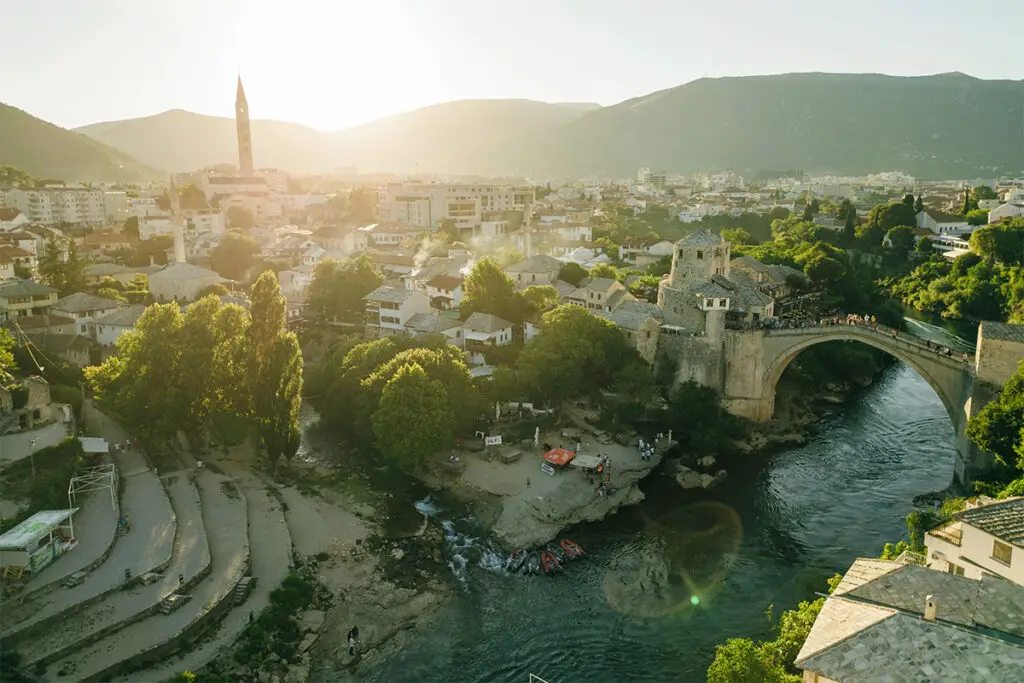
(Photo by depositphotos.com)
General regulations for commercial drone operations (SPECIFIC) in Bosnia and Herzegovina
The following rules apply to the commercial use of your drone:
- Daylight drone operations must be conducted within the operator’s line of sight, and the drone operator must be familiar with the environment in which they are operating the drone, designate a specific landing site and visibly mark it (in the case of autonomous landing). If the drone is operated outside the line of sight, the lateral distance to the drone operator must not exceed 1,000 metres.
- When operating at night, the drone must be equipped with light signalling systems, it may only be flown within the line of sight, the intended landing site must be in the immediate vicinity of the drone operator (in the case of an autonomous landing), and the maximum flight altitude may not exceed 30 metres above ground level.
- It is not permitted to fly a drone over crowds of people, important buildings and the like.
- Drone operators must have valid drone insurance that covers damage to third parties on the ground in the territory of Bosnia and Herzegovina, regardless of the mass of the drone.
- The minimum lateral distance from people, animals, buildings, vehicles, ships, roads, railways, waterways, power lines or other remote-controlled aircraft must be at least 30 metres.
- Drone operators who are unable to maintain the prescribed lateral distances in accordance with the previous point due to the environment and surrounding obstacles may fly the drone at a smaller lateral distance, but not less than 5 metres, whereby the flight altitude may not exceed 20 metres above ground.
- The maximum permitted flight altitude of a drone is up to 120 metres above ground or up to 50 metres above an obstacle.
- The lateral distance to industrial areas, embassies, state facilities and institutions as well as other public buildings must not be less than 100 metres.
- Drones may only be operated within an airport site at a distance of less than 1.5 kilometres from the airport or CTR zone with the prior consent of the competent air traffic control or airspace management cell (AMC), and the drone operator is obliged to comply with the terms of the consent.
- It is not permitted to fly a drone within a protected area that is located within 300 metres of the border line in the depth of the territory of Bosnia and Herzegovina, unless the drone operator or the owner of the drone has obtained prior consent from the Border Police of Bosnia and Herzegovina.
General regulations for aerial work with drones (CERTIFIED) in Bosnia and Herzegovina
Before starting drone operations, the drone operator must contact the BHDCA at [email protected] in order to obtain a special permit to carry out aerial work with drones in the airspace of Bosnia and Herzegovina.
Drones under the responsibility of foreign institutions (army, police, customs and other similar organisations) must obtain permission from the competent institution in Bosnia and Herzegovina before carrying out drone operations.
Registering a drone in Bosnia and Herzegovina
Under Article 13 of the drone regulation, registration is required for owners whose place of residence or registered office is in Bosnia and Herzegovina. They submit the complete application to the BHDCA, which issues a registration certificate within 30 days. The registration is valid for three years and must then be renewed. Unfortunately, the documents are currently only available in the local languages.
- %s
- %s
- %s
- %s
You will also need the following documents for the application:
- %s
- %s
- %s
- %s
- %s
How to pay the administrative fee is explained in the BHDCA payment instructions.
What applies to visitors from abroad?
The regulation has a separate article for foreign drone pilots (Article 19). If you fly privately, you must follow the rules for non-commercial flights described above. The regulation does not require you to register. For commercial flights and aerial work, however, you need prior approval from the BHDCA.
Whether the insurance requirement also applies to you as a tourist is left open by the ordinance. For private flights by foreigners, Article 19 only refers to the flight rules, while for commercial flights it explicitly includes the insurance requirement. We still recommend drone insurance that is valid in Bosnia and Herzegovina.
If you want to fly near an airport, you must first reserve the airspace with the Airspace Management Cell (AMC) of the air navigation service provider BHANSA. You do this via the BHANSA AMC portal. For private flights you must keep at least 1.5 kilometres from the airport and may fly no higher than 30 metres.
For all other information, you can contact the BHDCA directly by email at [email protected].
Have you flown your drone in Bosnia and Herzegovina? Did the BHDCA ask you for details about your drone as well? Leave us a comment below this article. Everyone who flies there after you will benefit from your experience.
We have researched the drone rules for Bosnia-Herzegovina listed here to the best of our knowledge. Unfortunately, we cannot guarantee the accuracy of the information. If you want to be on the safe side, contact the local aviation authority. Alternatively, you can ask the embassy of Bosnia and Herzegovina in your home country for more information about the regulations. Please leave us a comment if you have any news and/or have had any experiences with your drone in Bosnia and Herzegovina!

 Drone regulations in Jordan